A catalog-wide compositing pipeline built around exact product identity.
RECORD THROUGH SEPTEMBER 7, 2026
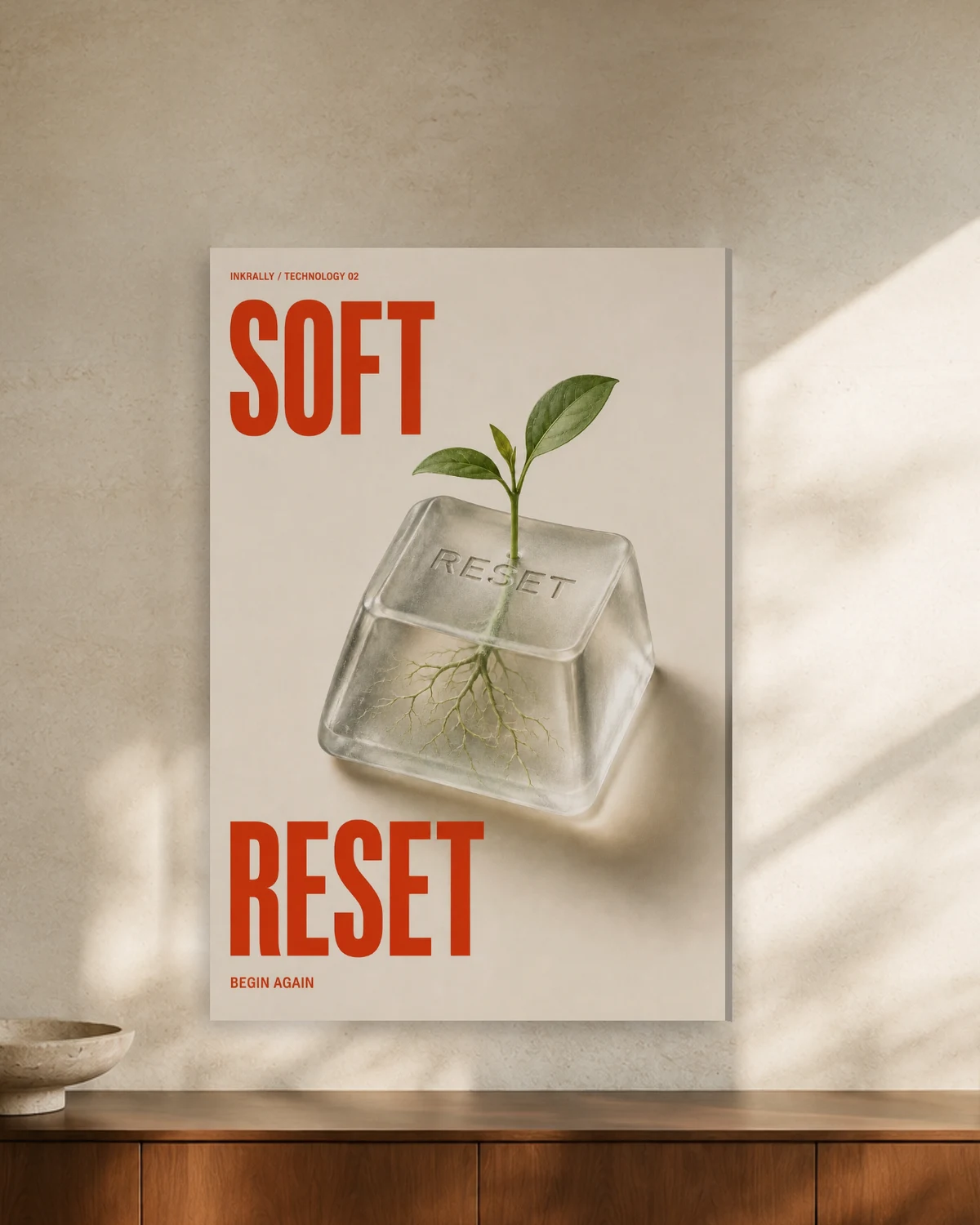
Soft Reset artwork composited into a limestone room
01 / THE QUESTION
Can every product have convincing room photography without regenerating the product itself?
Earlier imagery could look plausible while showing the wrong work or unrealistic product construction. The revised pipeline uses generated environments and deterministic compositing of the selected artwork. The images show styling possibilities; they are not photographs of manufactured samples.
WHAT THE WORK SHOWED
The scene and the artwork became separate inputs. Five generated photographic plates were combined with each selected composition, producing 775 distinct storefront images for 155 products.
02 / THE METHOD
The decisions behind the output.
01
Lock the product source
Each product resolves to its selected signed composition. The renderer normalizes embedded image formats where needed and checks the decoded image for blank or transparent output before compositing.
02
Map it into the scene
A projective transform maps the art plane to the photographed canvas plane. Inverse mapping and bilinear sampling assign artwork pixels to the target surface; lighting modulation and shadows integrate that surface with the room.
03
Build the gallery and audit it
The pipeline produces a room hero, a study view, a studio detail, a lounge, and an entry scene. Source and output hashes record the exact inputs and distinguish finished files. Product data assigns the matching images to each page.
03 / TECHNICAL NOTES
How the parts fit together.
Perspective without redrawing
The mapping changes how the selected composition is viewed, while using that artwork as the source. Reflected edge pixels supply the visible canvas side. This styling treatment is independent of the manufacturing wrap layout.
Fail before exporting an empty product
An embedded image format was incompatible with the SVG renderer on the development machine. Normalizing that embedded image to lossless PNG avoids a blank render while retaining the surrounding composition. Opacity and entropy checks catch empty decoding.
Verify identity as well as quantity
A five-image array can be complete and still contain the wrong art. The audit pairs source identity with per-product file references, and the live route check verifies the gallery references and structured product data across the catalog.
01Selected composition
02Perspective + light
03Five scene exports
04Identity + route checks
04 / THE REVISION
Where the approach changed.
BEFORE
Generated scenes and unrelated fallback imagery could weaken product accuracy.
AFTER
Each product received five matching images, with source identity retained in the render audit.
The decision: Ethan approved compositing the exact artwork into photographic environments.
ETHAN / DIRECTION & REVIEW
Ethan flagged implausible imagery and approved the exact-art compositing direction.
GPT-6 + TOOLS / EXECUTION
GPT-6 directed the image tool for photographic plates, wrote the Sharp-based compositor, integrated the galleries, and ran file and browser checks.
05 / EVIDENCE & LIMITS
What supports the claim.
File audit
The render record contains 155 products with five images each. All 775 finished image hashes are distinct.
Live route audit
The September 7 check passed on all 155 product pages and their structured product data, covering 775 image references.
Limit
Hashes and page checks establish traceability and coverage. They do not prove physical color, texture, hanging scale, or sample quality.
Based on retained project records and selected public artifacts. Historical checks describe the recorded release; they are not continuous monitoring or an independent audit.
THE NEXT CHECKPOINT
Replace or supplement generated styling scenes with photographs of the received physical samples.